
Table of Contents
- Why Hidden Mold Thrives in Walls, Attics, and Crawl Spaces
- Signs of Mold in Walls You Should Never Ignore
- How to Use a Moisture Meter for Mold Detection
- Infrared Thermal Imaging for Mold Detection
- Room-by-Room Guide to Finding Hidden Mold in a Home
- Professional Mold Inspection Cost and When to Call an Expert
- Smart Home Moisture Monitoring and Post-Remediation Verification
- Frequently Asked Questions
Last Updated: September 16, 2026
Why Hidden Mold Thrives in Walls, Attics, and Crawl Spaces
Hidden mold is fungal growth that develops out of sight, typically inside wall cavities, above ceiling tiles, or beneath flooring where moisture lingers undetected. This guide walks through methods to locate it before it spreads.
Signs of Mold in Walls You Should Never Ignore
The clearest signs of mold in walls are discoloration, warped wood, peeling wallpaper, and a persistent musty odor. Any one of these points to moisture that has been present long enough to support fungal growth.
Discoloration, Warped Wood, and Peeling Wallpaper
Discoloration shows up as greenish-black, gray, or brown patches, often near baseboards and corners. Warped wood and bubbling paint signal that porous materials have absorbed water. Peeling wallpaper is a common tell on exterior walls, where condensation forms behind the paper.
Musty Odors and Airborne Spore Counts
A musty odor means spores and airborne contaminants are already circulating through the HVAC system. If the smell is strongest in one room, that room is your starting point. The CDC’s guidance on mold and dampness notes that damp buildings can affect indoor air quality and trigger allergic reactions and respiratory issues in sensitive people.
How to Use a Moisture Meter for Mold Detection
A moisture meter is the cheapest diagnostic tool a homeowner can own, but most people use it wrong. The reading itself is meaningless without a baseline, and the type of meter you buy determines which surfaces you can actually test.
Pin-Type vs. Pinless Meters
There are two meter designs, and they answer different questions.
- Pin-type (resistance) meters drive two metal probes into the material and measure how easily current passes between them. Water conducts, so wetter material reads higher. These are the most accurate option for wood framing, subflooring, and joists, but they leave two small holes in whatever you test. On finished drywall or painted trim, that damage is permanent.
- Pinless (capacitance) meters press a sensor plate flat against the surface and read dielectric properties through the material, roughly 3/4 to 1 inch deep. They leave no marks, which makes them the right tool for finished walls, tile, and ceilings. The trade-off is that they average the moisture across that depth, so a thin wet layer over dry substrate can read lower than it should.
Establishing a Baseline Before You Test
A moisture meter reports a relative number, not a percentage of water by weight. That number only means something compared to a dry reference point in the same house on the same day.
A Practical Inspection Sequence
- Test a dry reference area in the same room to establish a baseline.
- Scan the full wall with a pinless meter, moving slowly along baseboards, corners, and around any plumbing penetration.
- Switch to a pin-type meter and confirm any elevated zone on framing, subfloor, or exposed wood.
- Note the reading, the material, and the time of day.
- Re-test the same spot after 48 hours. If the number has not dropped, the moisture is being fed by something, not drying out.
- Mark persistent areas for a professional inspection.
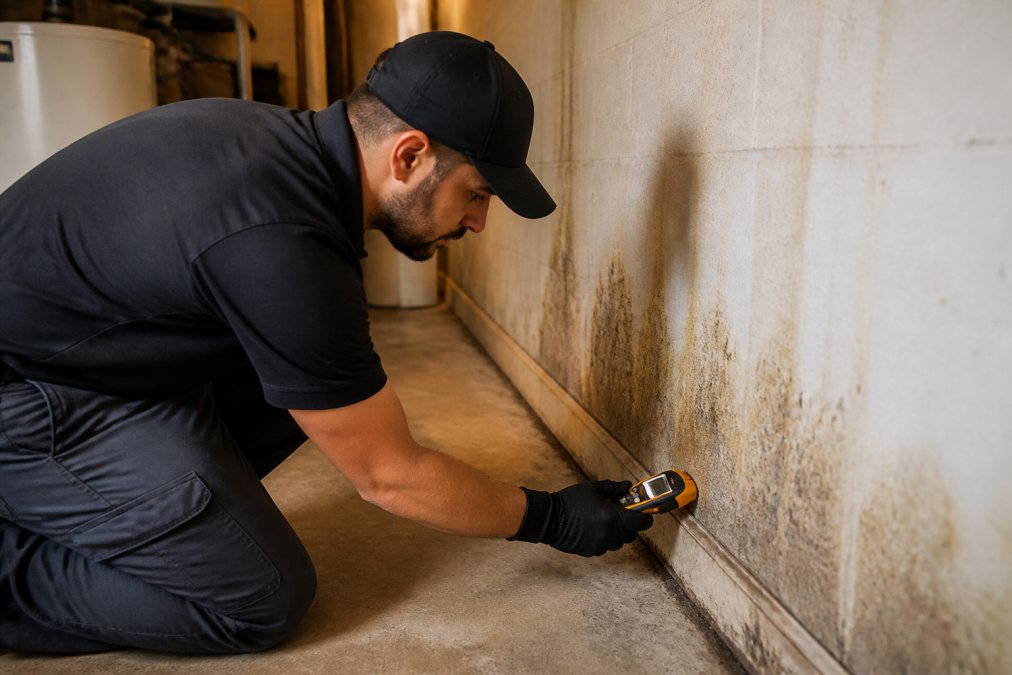
Consistent monitoring of these damp zones often reveals that moisture infiltration originates from the building envelope, making the practice of preventing exterior mold an essential component of any comprehensive moisture control strategy.
Why the Reading Drifts
Two things commonly confuse homeowners. First, a pinless meter reads an average across its sensing depth, so a wet paper-faced drywall layer over a dry stud can under-report. Second, metal studs, foil-faced insulation, and copper plumbing all distort capacitance readings. If a reading looks impossible, move the meter a few inches and try again before assuming the worst.
Infrared Thermal Imaging for Mold Detection
Infrared thermal imaging for mold detection works by revealing temperature differences that point to trapped moisture behind drywall, ceilings, and flooring. Wet materials cool differently than dry ones, so the camera exposes hidden damp zones without cutting into the wall.
Room-by-Room Guide to Finding Hidden Mold in a Home
Finding hidden mold starts with knowing where moisture collects. Work through each zone below and check the specific materials most vulnerable to fungal growth.
|
Zone |
What to Check |
Warning Sign |
|---|---|---|
|
Basement / crawl space |
Joists, insulation, subfloor |
Damp smell, efflorescence |
|
Bathroom |
Caulk lines, grout, exhaust fan |
Lifting caulk, soft drywall |
|
Kitchen |
Under-sink cabinet, dishwasher line |
Swollen particleboard |
|
Attic |
Roof decking, insulation edges |
Dark staining, warped wood |
|
HVAC |
Drip pan, duct lining, coils |
Musty air from vents |
Basements, Crawl Spaces, and Subfloors
Basement dampness and crawl space humidity are the most common sources. Check the subfloor above the crawl space, where condensation and seepage collect. Warped wood and a sharp musty odor here usually mean growth has been active for weeks.
Bathrooms, Kitchens, and HVAC Systems
In bathrooms and kitchens, look behind the toilet, under the sink, and around the dishwasher supply line. In the HVAC system, inspect the drip pan and duct lining. A clogged condensate line keeps the pan wet and pushes spores through every vent in the house.
Professional Mold Inspection Cost and When to Call an Expert
Professional mold inspection cost depends on the size of the property, the number of areas tested, and whether air quality testing is included, so pricing varies by scope. Call an expert when you find visible colonies larger than a small patch, when moisture keeps returning, or when occupants report ongoing respiratory issues. For an accurate figure on your specific property, contact Zenith Property Inspections directly for a quote based on your home’s square footage and inspection scope.
Smart Home Moisture Monitoring and Post-Remediation Verification
Most guides stop at “find the mold.” The two steps that actually protect a home are catching moisture before mold starts and proving the mold is gone after cleanup. Neither gets much coverage, so here is how both work.
How Smart Moisture Sensors Actually Work
A smart moisture sensor is a small battery-powered puck that reports relative humidity and temperature to a hub or phone app. The useful ones do three things:
- Log humidity over time, not just at the moment you check. Mold risk tracks sustained humidity, not a single spike.
- Trigger alerts at a threshold you set, so a slow supply-line drip under a sink gets caught in hours instead of months.
- Survive the environment they monitor. A crawl space sensor needs to handle near-100% humidity and temperature swings; a bathroom sensor does not.
Post-Remediation Verification: Proving the Mold Is Gone
Cleaning visible growth is not the same as fixing the problem. Post-remediation verification is the step that confirms three things: the moisture source is corrected, the affected materials are dry, and airborne spore levels inside the work area match outdoor or unaffected-area levels.
A typical verification includes:
- Moisture readings on the repaired materials, compared against a dry reference in the same structure.
- Visual inspection of the cavity or surface after containment is removed, looking for regrowth or missed staining.
- Air sampling, often a comparison of indoor and outdoor samples, or a “clearance” sample inside the contained area versus a reference sample outside it.
Allergy vs. Toxicity: Why the Distinction Matters
Not every mold reaction is the same problem, and conflating them leads people to the wrong response.
- Mold allergy is an immune response to inhaled spores. Symptoms resemble seasonal allergies, sneezing, itchy eyes, congestion, sometimes asthma flare-ups, and they show up in sensitive people, not everyone in the home. The fix is removing the source and reducing airborne spores.
- Mycotoxin exposure concerns toxins produced by certain species, most often associated with Stachybotrys chartarum (often called “black mold”). The health picture here is more contested and the research is less settled than headlines suggest. The practical response is the same: remove the moisture source and the contaminated material, and avoid disturbing growth without containment.
Frequently Asked Questions
What are the first signs of mold sickness from hidden mold?
Early signs of mold sickness include sneezing, runny nose, itchy eyes, coughing, and skin irritation, which often worsen when you are inside the home and ease when you leave. People with asthma or allergies may notice respiratory issues, wheezing, or shortness of breath. If symptoms track with time spent in a specific room, that is a strong signal to check for hidden mold near leaking pipes, condensation, or water damage behind walls.
Can you detect mold in a house without seeing it?
Yes. Hidden mold is often found through smell, moisture readings, and thermal imaging rather than visible colonies. A musty odor in a closed room, elevated relative humidity above 60%, or a moisture meter reading above 15% in drywall or wood all point to fungal growth behind surfaces. Infrared thermal imaging for mold detection reveals temperature anomalies from evaporative cooling, which can expose active moisture before mold becomes visible.
How much does a professional mold inspection cost?
Professional mold inspection cost depends on the size of the property, the number of suspect areas, and whether air quality testing or spore count lab work is included. Pricing also varies by region and by how many samples are collected. For an accurate figure on your specific property, contact Zenith Property Inspections directly for a quote based on your home’s square footage and inspection scope.
Where is the most common place for mold to hide in a home?
The most common hiding spots are basements, crawl spaces, subfloors, attic sheathing, inside wall cavities near leaking pipes, and around HVAC system components. Bathrooms and kitchens hide mold behind tile, under sinks, and in cabinet backs. Porous materials like drywall, insulation, and wood framing hold moisture longer than non-porous surfaces, which is why they are the first places mold spores settle and grow.