
Last Updated: November 23, 2026
Quick Summary
To verify inspector certifications, confirm the inspector’s license number on your state licensing board’s website and check any association memberships in directories like InterNACHI, ASHI, or CREIA. Check that each license and membership is active, not expired, and that the name matches your contract.
- Ask for the inspector’s full legal name and license number before booking.
- Look up the license on your state licensing board website, confirming the domain ends in .gov.
- Check that the license status is active and the expiration date is current on your inspection date.
- Search association directories and confirm membership is current and the certification level matches the claim.
- Keep written records of the dates and results of each check for your files.
Table of Contents
- How to Verify Inspector Certifications Step by Step
- Why Certification and Licensing Are Different
- Home Inspector License Lookup Through Your State Board
- Home Inspector Certification Lookup Through Professional Associations
- Red Flags to Watch for When Vetting an Inspector
- Questions to Ask a Home Inspector Before Hiring
- Booking Your Inspection With Zenith Property Inspections
- Frequently Asked Questions
How to Verify Inspector Certifications Step by Step
Hiring a home inspector is one of the few steps in buying a house where you can’t easily check the work afterward. Verifying an inspector’s credentials before you book takes about 15 minutes and can save you from a poor inspection. Every buyer, seller and investor should know how to check an inspector before handing over a check.
Learning how to verify inspector certifications means confirming, with an official source, that the person holds the license or credentials they claim. Most of the work happens in two places: your state’s licensing board and the websites of professional associations. Here is the process we recommend.
- Step 1: Ask for the inspector’s full legal name and license number.
- Step 2: Look up that license on your state’s licensing board website.
- Step 3: Check any association memberships or certifications the inspector lists.
- Step 4: Confirm the insurance and any specialty certifications, such as mold or pool.
- Step 5: Write down the dates and results so you have a record.
Watch out: A certification name on a website can be real but expired. Always check the status and expiration date, not just the name.
The five steps below summarise the verification process, with the timing and purpose of each.
| Step | What to do | Time or frequency |
|---|---|---|
| Step 1 | Ask for the full legal name and license number | Before booking |
| Step 2 | Look up the license on the state licensing board site | About 5 minutes |
| Step 3 | Check association memberships or certifications listed | Before booking |
| Step 4 | Confirm insurance and specialty certifications | Before booking |
| Step 5 | Write down dates and results as a record | Keep for your files |
Why Certification and Licensing Are Different
A license and a certification are not the same thing, and mixing them up is a common mistake. A license is a legal requirement from your state to perform inspections for pay. A certification is usually a voluntary credential from a private group that shows extra training or experience.
Some states require a license, while others have no state licensing for home inspectors at all. Even in states without a license, an inspector may still hold certifications from national organizations. Knowing which kind of credential you are looking at tells you what it actually proves.
For a deeper look at what each credential means, see our complete guide to home inspector credentials.
Home Inspector License Lookup Through Your State Board
Your state’s licensing board is the most reliable place to confirm that an inspector is legally allowed to work. The trick is knowing which agency to search, because home inspector oversight is scattered across different departments depending on where you live. In some states it sits with a real estate commission, in others with a department of professional and occupational regulation, a department of licensing, or a consumer affairs division. A quick search for “[your state] home inspector license lookup” usually surfaces the right agency, but confirm the domain ends in .gov before you trust it.
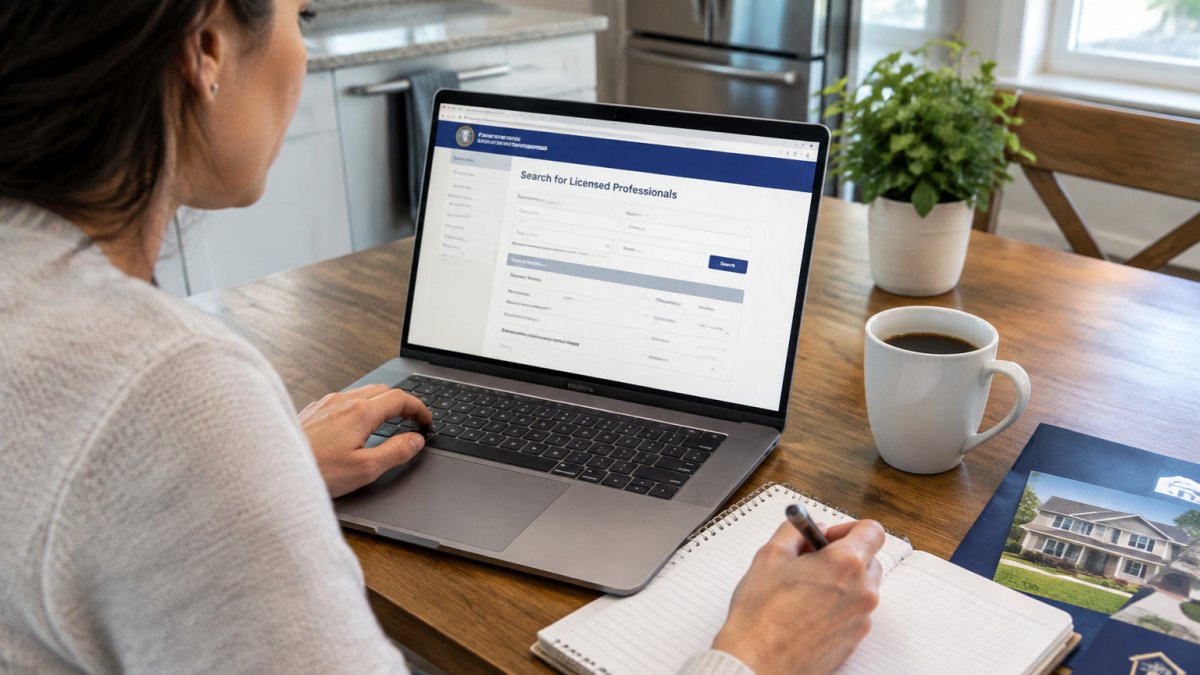
Many state boards run a public license search that accepts either the inspector’s full legal name or the license number. The license number is faster and avoids the problem of common names returning dozens of records. When the record loads, read it carefully rather than just confirming the name appears.
What a license record typically shows:
- License status, active, expired, suspended, revoked, or probationary. An expired or suspended license means the inspector is not currently authorized to perform paid inspections.
- License type and scope, some states issue a single home inspector license, while others separate categories such as associate, licensed, and certified, or distinguish residential from commercial authority.
- Issue and expiration dates, confirm the license is current as of your inspection date, not just the date you searched.
- Disciplinary actions, many boards publish complaint history, consent orders, fines, or suspensions. A single old complaint is not automatically disqualifying, but a pattern of findings is a serious signal.
- Business or assumed name, this is where mismatches show up. If the license is issued to an individual but your contract is with a company, confirm the individual is the one who will actually perform the inspection.
Watch out: Some boards list a license as “active” even when a disciplinary order is in place, so read the full record and any linked documents rather than stopping at the status field.
A few practical notes. Records are often updated on a lag, so a recently renewed license may still show the prior expiration date for a few days. If the inspector’s name does not appear at all, ask them which name and license number they are registered under, a legal name change or a DBA can explain a missing result, but so can an unlicensed operator. And resist the paid lookup sites that rank above the official board page; they resell public records that the state provides free. Verifying specialized credentials like lead abatement requires extra diligence, so incorporate this checklist into your vetting process to ensure every safety standard is met.
If your state has no home inspector licensing at all, there is no board record to check, and you will need to lean on the association and insurance checks covered in the next sections. That absence is itself useful information: it tells you the certification lookup and the sample-report review are doing more of the work.
Home Inspector Certification Lookup Through Professional Associations
Professional associations such as InterNACHI, ASHI, and CREIA maintain their own member directories, and these are the second place to verify credentials after the state board. A directory listing confirms membership, but the details behind the listing matter more than the badge on the inspector’s website.
How the directories are organized:
- InterNACHI runs a searchable inspector locator that lets you filter by location and shows membership status and any additional certifications the member holds, such as Certified Professional Inspector designations and specialty credentials.
- ASHI publishes a member directory that distinguishes between different membership levels and lists certified inspectors separately from general members. Its Certified Inspector program requires passing an exam and meeting inspection-experience thresholds.
- CREIA maintains a member roster with certification levels and requires continuing education to stay listed.
Search each directory by the inspector’s name and location, then compare the result against what the inspector claims on their website and in their contract. Three things are worth confirming:
- Membership is current. Directories usually show a status or expiration date. A lapsed membership can still appear in cached search results or on the inspector’s own marketing pages.
- The certification level matches the claim. “Member” and “Certified Inspector” are not the same thing, and some associations offer multiple tiers. If the website says “certified” but the directory shows a basic membership, ask which credential they mean.
- The business information lines up. The directory listing should match the company name, service area, and contact details on the inspector’s site. A mismatch is not proof of a problem, but it is a question worth asking.
Watch out: Association membership is voluntary and is not a substitute for a state license. An inspector can be a dues-paying member of a national association and still be unlicensed in a state that requires a license, check both, not one or the other.
If an inspector claims a membership that does not appear in the directory, ask them directly rather than assuming the worst. Memberships lapse, names change after a business rebrand, and some inspectors belong to regional groups that are not part of the national directories. The answer you get, clear and documented, or vague and defensive, tells you as much as the directory result itself.
For a deeper look at what each credential means and how the tiers differ, see our complete guide to home inspector credentials.
Red Flags to Watch for When Vetting an Inspector
Some warning signs show up again and again when people check inspectors. Watch for these during your search:
- No license number is offered when you ask for one
- The name on the license does not match the name on the contract
- Certifications listed on the website cannot be found in any official directory
- Pressure to book immediately or to skip the paperwork
- A price that is far below other local inspectors with no clear reason
- Unwillingness to provide a sample inspection report
- Vague answers about insurance coverage
If you see more than one of these, keep looking. A good inspector will welcome the check and make the information easy to find.
Questions to Ask a Home Inspector Before Hiring
Verifying credentials is only part of vetting. Ask a few direct questions before you hire, and pay attention to how clear the answers are:
- What is your state license number, and when does it expire?
- Which professional associations are you a member of?
- Do you carry errors and omissions insurance and general liability insurance?
- What does your inspection cover, and what does it leave out?
- Can I see a sample report?
- How long will the written report take, and what format will it be in?
- Do you handle specialty inspections, such as mold, pool or older plumbing?
Clear, quick answers are a good sign. Hesitation or evasion is worth noting.
Booking Your Inspection With Zenith Property Inspections
Once you have verified an inspector, booking is the next step. At Zenith Property Inspections, our team is led by a National Housing Code Certified Master Inspector, and we use DJI drone technology and infrared thermal imaging to look at hard-to-reach areas. We offer Saturday and Sunday appointments at no extra charge, and reports are delivered the same day.
You can check our credentials using the steps above before you book. For guidance on what to expect from the appointment itself, read our guide to what to expect from a home inspection. When you are ready, book a professional inspection online and we will walk you through the next steps.
Frequently Asked Questions
How do I verify a home inspector’s certification?
Start by checking the inspector’s license with your state licensing board, which in California is the Department of Consumer Affairs. Then look up any professional association membership, such as InterNACHI or ASHI, on that organization’s public member directory. Confirm the name on the license matches the name on the inspection contract and the report. Ask the inspector for their license number up front so you can search it directly, and be cautious of any inspector who hesitates to share it.
Is home inspector certification the same as a license?
No. A license is issued by a state authority and gives legal permission to perform inspections where the state requires one. A certification is usually granted by a private professional association after training, testing, or experience requirements are met. An inspector can hold both, one, or neither depending on the state. Verify the license first because it is the legal requirement, then review any certifications as added evidence of training.
What questions should I ask a home inspector about their credentials?
Ask for the license number, the issuing state agency, and any association memberships along with the membership number. Ask how many inspections they have completed and whether they carry errors and omissions insurance. Ask which standards of practice they follow, and whether they are trained in the specialty areas you need, such as mold, pool, or drone and thermal imaging assessments. Clear, specific answers are a good sign.
What should I do if I cannot verify an inspector’s credentials?
Do not hire the inspector until the credentials are confirmed. If the license does not appear in your state’s public lookup, ask the inspector to explain the discrepancy and provide documentation. If the answer remains unclear, choose a different inspector whose license and memberships you can verify independently. Your real estate agent or escrow officer can also point you to inspectors they have worked with before.
