
Last Updated: October 25, 2026
Quick Summary
Home inspector credentials include state licenses, professional certifications from organizations like ASHI and InterNACHI, and specialty certifications in areas such as mold inspection and thermal imaging. A majority of states require licensing with pre-licensing education, a standardized exam, and continuing education, while roughly a dozen states do not require licenses, making professional certification the key credential.
- Most licensing states require 40 to 200 hours of pre-licensing coursework before taking the National Home Inspector Examination.
- Field experience requirements typically range from 50 to 100 supervised or parallel inspections before a license is issued.
- In non-licensing states, professional certification from ASHI or InterNACHI and liability insurance become the primary credentials to verify.
- Specialty certifications in mold inspection, radon testing, thermal imaging, and pool inspection require additional training beyond standard home inspection.
- Verify credentials directly with state regulators and certifying organizations rather than relying on inspector websites or badges.
Table of Contents
- Understanding Home Inspector Credentials and Why They Matter
- Home Inspector License Requirements Across States
- Professional Certifications and Designations
- Education, Training, and Examination Requirements
- How to Verify a Home Inspector License and Certification
- Thermal Imaging Certification for Home Inspectors
- Questions to Ask a Home Inspector About Credentials
- Insurance, Liability, and Consumer Protection
- Frequently Asked Questions
Understanding Home Inspector Credentials and Why They Matter
When you’re investing hundreds of thousands of dollars in a property, you need someone qualified to tell you what’s wrong with it.
The credential landscape is fragmented: some states require licenses, others don’t, and some certifications mean far more than others. At Zenith Property Inspections, we’ve seen how credentials separate thorough inspectors from those cutting corners.
What matters most is understanding what each credential represents: a license means you passed your state’s requirements, a professional certification means you met national standards, and a specialty credential means you’ve trained in a specific area like mold or thermal imaging.
Home Inspector License Requirements Across States
Licensing is a state-level function, and the rules range from strict to nonexistent. There is no federal home inspector license, so the credential that matters depends entirely on where the property sits.
States That Require Licensing
A majority of states require home inspectors to hold a state-issued license. The common building blocks are consistent even when the details differ:
- Pre-licensing education. Most licensing states require completion of an approved course, typically in the 40- to 200-hour range. A few states set the floor higher.
- A standardized exam. The National Home Inspector Examination (NHIE) is the most widely used licensing exam, though some states administer their own. NHIE overview
- Field experience or supervised inspections. Several states require a set number of parallel or supervised inspections before a license is issued, commonly in the range of 50 to 100, though the number varies.
A few examples illustrate the spread. Texas requires a licensed professional inspector, pre-licensing coursework, the NHIE or an approved alternate, and continuing education. Florida licenses inspectors through its Department of Business and Professional Regulation and requires a state exam and insurance. California, by contrast, does not license home inspectors at the state level, a fact that surprises many buyers.
States Without Licensing Requirements
Roughly a dozen states plus the District of Columbia do not require a state home inspector license. There, anyone can legally advertise home inspection services without proving education, passing an exam, or carrying insurance.
This is the single most important thing a buyer can know before hiring: in a non-licensing state, the burden of verifying qualifications shifts entirely to you. In a licensing state, you can at least confirm a baseline through the regulator.
How the Patchwork Affects You
In a licensing state, ask for the license number and verify it with the state regulator, not the inspector’s website. In a non-licensing state, ask about national certification (ASHI or InterNACHI), specialty credentials, insurance, and the standards the inspector follows. The absence of a license is not automatically a red flag; the absence of any verifiable credential is.
Professional Certifications and Designations
Professional certifications fill the gap where licensing doesn’t exist and add credibility where it does.
National Certifications and Professional Associations
The two dominant national certification bodies are InterNACHI and ASHI, which set standards and administer exams independently of state licensing. Membership in either organization signals that an inspector has met national standards, even if their state doesn’t require a license.
ASHI’s certification requires passing the National Home Inspector Examination and meeting continuing education requirements; InterNACHI offers similar certification with its own exam and standards. Both maintain codes of ethics and inspection standards.
Inspectors can also pursue designations like Certified Professional Inspector (CPI) or Certified Master Inspector, which require additional training and examination. A Certified Master Inspector designation demonstrates advanced expertise and years of field experience, a signal of going beyond minimum requirements.
Specialty Certifications
Home inspectors often pursue credentials in specialized areas such as mold inspection, radon testing, and wind mitigation, each requiring additional training in detection methods, safety protocols, and reporting standards.
At Zenith Property Inspections, we hold specialty certifications including certified mold inspection and pool inspection credentials, allowing us to provide comprehensive assessments beyond standard home inspection scope.
|
Credential Type |
What It Covers |
How to Verify |
|---|---|---|
|
State License |
Government-mandated baseline requirements |
Contact state regulatory board |
|
Professional Certification (ASHI/InterNACHI) |
National standards and ethics |
Check member directory on organization website |
|
Specialty Certification |
Focused expertise in one area (mold, radon, pools) |
Ask for certificate; verify issuing organization |
|
Master Inspector Designation |
Advanced experience and expertise |
Confirm with certifying body |
Education, Training, and Examination Requirements
Becoming a qualified home inspector requires formal education and examination.
Pre-licensing coursework typically covers building systems, inspection standards, report writing, and business practices, ranging from 40 to 200 hours depending on state requirements.
The licensing exam, usually the NHIE, tests knowledge of construction, electrical systems, plumbing, HVAC, roofing, and structural components.
Continuing education maintains credentials.
How to Verify a Home Inspector License and Certification
Most guides explain how to become an inspector; far fewer explain how to check one. This is the consumer-verification playbook: where to look, what to search, and what a clean result proves.
Step 1: Confirm Whether Your State Licenses Inspectors
Start with the regulator, not the inspector. Search your state’s real estate commission, department of licensing, or consumer protection agency, the agency name varies. If your state does not license home inspectors, skip to the certification checks below; there is no state record to pull. If it does, you will usually find a public license lookup tool.
Step 2: Pull the License Record
Most licensing states maintain a searchable online database. Search by the inspector’s name or license number and confirm four things:
- Status. Active, expired, suspended, or revoked. An expired license is not a license.
- License type. Some states tier licenses (for example, a standard license versus a more advanced or professional designation). Confirm the tier matches what the inspector claims.
- Disciplinary history. Many databases list complaints, consent orders, fines, or suspensions. A single old complaint is not disqualifying; a pattern is.
- Expiration date. Confirm the license is current as of your inspection date, not just historically valid.
If your state’s lookup is hard to find, call the regulator’s licensing line and ask for the inspector’s record directly.
Step 3: Verify National Certification
National certification is voluntary and lives with the certifying organization, not the state. The two dominant bodies are ASHI and InterNACHI. Both maintain online member directories:
- ASHI. Search the ASHI member directory by name and location. Confirm the inspector is a current member in good standing and note their membership level. ASHI member directory
- InterNACHI. Search the InterNACHI inspector locator. Confirm current certification status and any listed designations. InterNACHI inspector locator
A lapsed membership or expired certification is a red flag, but easy to miss because directories sometimes retain historical listings. Ask for a current certificate or membership card and compare the dates.
Step 4: Verify Specialty Credentials
Specialty credentials, mold, radon, thermal imaging, pool and spa, wind mitigation, are issued by a mix of national bodies, state programs, and equipment manufacturers, with no single national registry. Ask for the certificate, note the issuing organization, and verify directly with it. If an inspector cannot name the issuing body, treat the claim as unverified.
Step 5: Ask for Proof and Cross-Check the Story
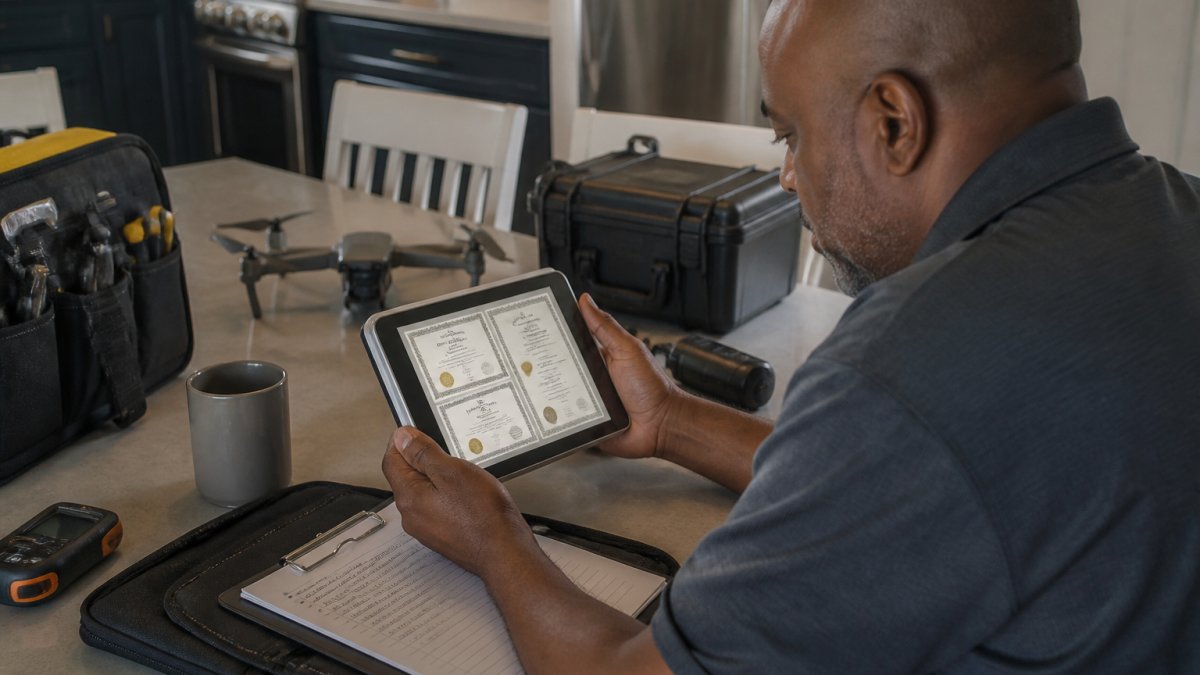
Ask the inspector to send copies of the license, certification cards, insurance certificate, and any specialty credentials. A qualified inspector will provide them without hesitation. Then cross-check: does the license number match the state database? Does the certification date match the organization’s directory? Inconsistencies between claims and records are the clearest warning sign you will get.
What Verification Does and Does Not Prove
A clean verification confirms the inspector met a defined baseline, education, exam, and standing with a regulator or certifying body. It does not guarantee the quality of any single inspection, nor replace reading the inspection agreement, confirming insurance, and asking about experience.
For a broader framework on evaluating an inspector beyond credentials, see what is important when hiring a home inspector?.
Thermal Imaging Certification for Home Inspectors
Thermal imaging, infrared technology that detects heat patterns, reveals problems invisible to the naked eye, including moisture intrusion, missing insulation, and electrical hotspots.
Thermal imaging certification requires training in operating infrared cameras, interpreting thermal images correctly, and understanding the technology’s limitations. Learn more about thermal imaging certification costs to understand the investment required for this specialty credential.
The certification covers how thermal imaging works, what it can and cannot detect, how environmental factors affect readings, and how to document findings.
When hiring an inspector who uses thermal imaging, ask about their certification. Have they completed formal training in thermal imaging interpretation?
Questions to Ask a Home Inspector About Credentials
Ask specific questions about credentials before hiring.
If they claim mold inspection or thermal imaging, ask for proof of certification in those areas.
Ask whether they follow ASHI or InterNACHI standards, the recognized national standards for home inspection.
Ask about their experience. How many inspections have they completed? How long have they been in business?
You can also reference what is important when hiring a home inspector? for a comprehensive guide on what to evaluate when selecting an inspector.
Insurance, Liability, and Consumer Protection
Professional liability insurance, often called errors and omissions insurance, protects you if an inspector misses something significant.
Most states that license inspectors require liability insurance as part of the licensing process.
Consumer protection laws vary by state.
The inspector’s credentials and insurance work together to protect you.
Credentials matter because they signal competence, commitment to standards, and accountability.
Frequently Asked Questions
What credentials should home inspectors have?
Home inspectors should hold a state license where required, professional certification from organizations like ASHI or InterNACHI, and proof of liability insurance. Many states require 40–200 hours of approved training and passage of the National Home Inspector Examination (NHIE). Specialty credentials in mold inspection, radon testing, or thermal imaging demonstrate additional expertise. The specific credentials depend on your state’s regulations and the scope of inspection you need.
Do home inspectors need a license?
Licensing requirements vary significantly by state. According to InterNACHI, each state or province has its own certification or licensing requirements—some regulate inspectors through licenses while others do not. Approximately 37 states require a license, registration, or certification, while 13 states and Washington, D.C., do not. Always check your specific state’s requirements before hiring an inspector.
How can I verify a home inspector’s license or certification?
Contact your state’s regulatory board or licensing agency directly using their online verification system. Ask the inspector for their license number, certification credentials, and professional association memberships. Request proof of errors and omissions insurance and ask about their training hours and exam results. Verify membership with ASHI or InterNACHI through those organizations’ websites, and check for any complaints or disciplinary actions on file.
Does a home inspector need special training to use thermal imaging?
Yes. Thermal imaging certification for home inspectors requires specialized training beyond standard inspection coursework. This training covers how to properly operate infrared cameras, interpret thermal images, understand limitations of the technology, and document findings accurately. Certified thermal imaging inspectors can identify hidden moisture, insulation gaps, electrical hot spots, and other issues invisible to the naked eye, providing significantly deeper property assessments than standard inspections alone.
What is the difference between a home inspector license and certification?
A license is a legal credential issued by a state regulatory body that permits someone to work as a home inspector in that jurisdiction. Certification is a voluntary professional designation awarded by organizations like ASHI or InterNACHI after meeting education, exam, and experience standards. A licensed inspector may not be certified, and a certified inspector in an unlicensed state may not hold a license. Both signal competence, but they operate under different frameworks.
Should a home inspector have errors and omissions insurance?
Yes. Errors and omissions (E&O) insurance protects you if an inspector misses a significant issue that later costs you money to repair. Professional inspectors carry E&O coverage as proof of accountability and financial responsibility. This insurance is often required by state regulators or professional associations and demonstrates that the inspector takes their work seriously and stands behind their reports.
What questions should I ask before hiring a home inspector?
Ask about their license and certification status, years of experience, and whether they hold specialty certifications relevant to your property. Inquire about their liability insurance coverage, what inspection standards they follow, whether they use advanced tools like thermal imaging, and how they deliver reports. Ask about their availability for weekend appointments, turnaround time for reports, and whether they’ll explain findings in person. Request references from recent clients and clarify what is and isn’t included in the inspection scope.
