
Last Updated: November 21, 2026
Quick Summary
Thermal imaging is essential for basement wall cracks because it reveals hidden moisture and temperature anomalies that visual inspection misses, especially behind finished walls. The camera narrows the search, but every cold spot must be confirmed with a moisture meter before you diagnose water intrusion.
- A wall can look and even read cold for many reasons, so visual walkthroughs cannot confirm moisture.
- Thermal cameras read surface temperature patterns and do not see through walls.
- Hold the camera perpendicular to the wall at a consistent distance of 3 to 5 feet.
- Confirm every flagged anomaly with a pin-type or pinless moisture meter.
- Call a professional when a crack is wider than a quarter inch, horizontal, moving, or wet.
Table of Contents
- Why Visual Inspection Misses Most Basement Wall Cracks
- How Thermal Imaging for Moisture Detection Reveals Hidden Problems
- Using an Infrared Camera for Water Leak Detection Behind Finished Walls
- A Step-by-Step Basement Crack Inspection Workflow
- Moisture Meter vs Thermal Camera: How the Two Tools Work Together
- Thermal Imaging Limitations for Moisture and Crack Detection
- Reading Crack Severity and Knowing When to Call a Professional
- Schedule Your Thermal Basement Inspection
- Frequently Asked Questions
Why Visual Inspection Misses Most Basement Wall Cracks
A flashlight and a trained eye catch a lot. They still miss most of what matters in a basement. According to guidance from the American Society of Home Inspectors, a wall can look and even read cold for many reasons, and a visual walkthrough cannot tell you which one you are dealing with.
Here is the core problem. Basement wall cracks rarely announce themselves. Hairline cracks hide behind shelving, paint, insulation, or a finished wall. Water intrusion often starts inside the wall cavity, where nobody looks until the damage shows up as staining or a musty smell.
Visual inspection is a starting point, not a verdict. It tells you what is visible. It cannot tell you what is happening behind the surface. For a closer look at what thermal imaging adds to a standard home inspection, see what thermal imaging reveals during a home inspection.
How Thermal Imaging for Moisture Detection Reveals Hidden Problems
Thermal imaging for moisture detection works by reading surface temperature patterns, not by seeing through walls. An infrared camera captures tiny temperature differences across a wall. Wet concrete, damp drywall, and trapped moisture hold and release heat differently than dry material. That difference shows up as a thermal anomaly on the camera screen.
A 2025 review in Sustainable Development of Civil, Infrastructure, and Environment describes how cracks, subsurface damage, and hidden defects can produce changes that appear in thermal images. A separate 2022 study in Case Studies in Construction Materials reported that infrared thermography can help monitor crack movement, detachments, and surface changes caused by moisture and mold.
What most guides miss is the confirmation step. A cold spot is a clue, not a diagnosis. The camera tells you where to look. A moisture meter tells you whether it is actually wet.
Using an Infrared Camera for Water Leak Detection Behind Finished Walls
An infrared camera for water leak detection is the fastest way to find a hidden leak without tearing into a finished basement. Thermal imagers detect surface temperature patterns rather than seeing through wall materials.
Here is what that looks like in practice:
- A cold vertical streak usually points to water running down a stud cavity
- A cold patch near the ceiling line often signals a leak from above
- A cold band along the floor suggests water wicking up from the slab
- An irregular cold shape around a window or pipe penetration points to air or water entry
The camera narrows the search. It does not replace a moisture reading. If you suspect mold has already started behind a finished wall, our guide on how to detect mold behind walls walks through the warning signs and next steps.
A Step-by-Step Basement Crack Inspection Workflow
A repeatable workflow beats a random walk with a camera. This is the sequence we follow on a thermal basement inspection, from preparation through follow-up.
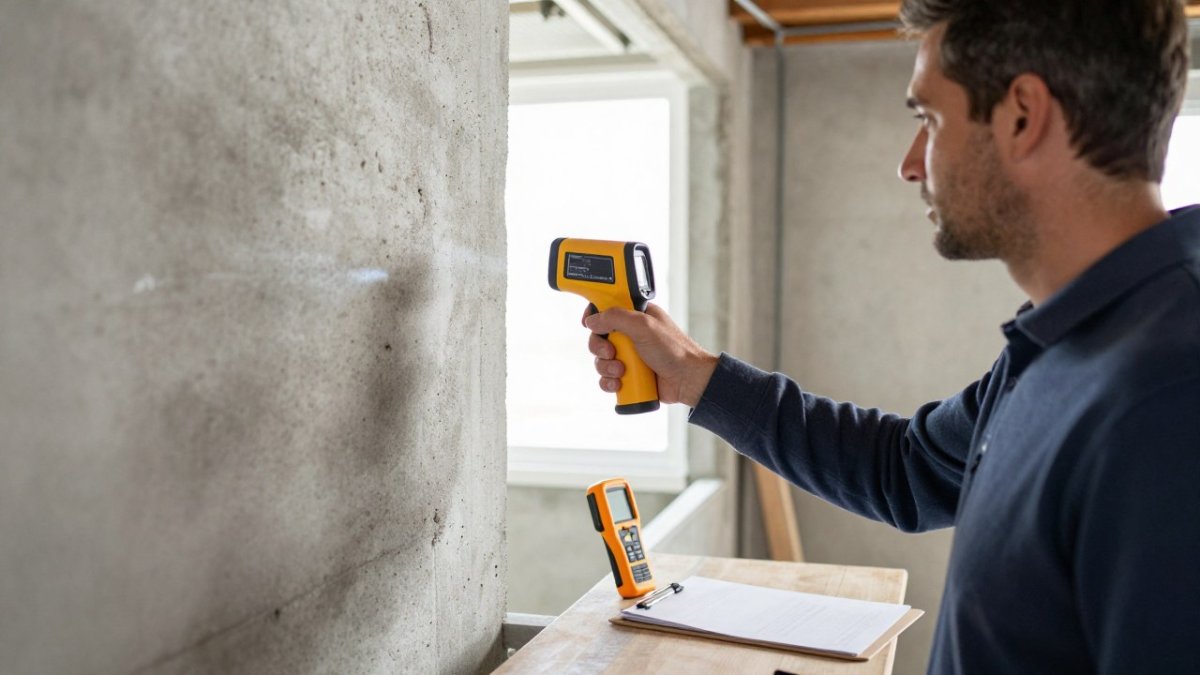
1. Prepare the basement for temperature contrast. Thermal imaging relies on temperature differences, so the basement needs a meaningful temperature contrast with the wall surface for cracks and moisture to stand out. Close windows and exterior doors, turn off fans that move air across the walls, and let the space stabilize for a few hours.
2. Set up the camera correctly. Adjust the camera’s emissivity setting for concrete (most manufacturers provide a preset), set the temperature range to capture the expected spread, and turn on the color palette that best highlights anomalies.
3. Scan the full foundation wall systematically. Sweep slowly, top to bottom, in overlapping vertical passes. Watch for temperature variation along the concrete, paying special attention to corners, pipe penetrations, window wells, and the floor-wall joint where water often enters. Note any crack that is visible to the eye and compare its thermal signature to the surrounding wall.
4. Mark every thermal anomaly. Flag cold or warm spots with tape before you lose track of them. A cold vertical streak, a cold patch near the ceiling line, or an irregular shape around a penetration each tells a different story, so label them as you go.
5. Confirm with a moisture meter. Test each flagged area with a pin-type or pinless moisture meter. A wet reading confirms moisture; a dry reading means you found something else, an air leak, missing insulation, or a thermal bridge. Record the meter reading alongside the thermal image.
6. Photograph and document. Capture the thermal image, the meter reading, and a standard photo side by side. Note the time, the indoor and outdoor temperatures, and the camera settings so the findings can be reproduced or verified later.
7. Map the affected area and plan follow-up. Note how far the anomaly spreads, because that drives repair decisions. Once the affected area is mapped, comparing it with tools for checking damp can help distinguish a persistent moisture problem from a dry thermal pattern.
The camera does not need to touch the wall. That is the whole point of a non-destructive inspection.
Moisture Meter vs Thermal Camera: How the Two Tools Work Together
A moisture meter vs thermal camera comparison is not really a competition. The two tools answer different questions, and you need both.
| Tool | What It Tells You | Best Use | Limitation |
|---|---|---|---|
| Thermal camera | Where temperatures differ | Finding the search area fast | Cannot confirm water |
| Moisture meter | Whether material is wet | Confirming a suspected spot | Only reads where it touches |
| Visual inspection | What is visible | Documenting cracks and stains | Misses hidden issues |
Thermal Imaging Limitations for Moisture and Crack Detection
Thermal imaging limitations for moisture start with one hard fact: thermal cameras do not see through walls. They read surface temperature. A wall can be cold because of a draft, missing insulation, a shadow, or a plumbing line, not just water. The camera shows you a pattern; it does not tell you the cause.
A thermal camera can be right or wrong about moisture, because cold has many causes. That is why every anomaly needs confirmation.
How to tell a crack-related anomaly from other causes. Most misleading patterns fall into a few recognizable categories:
- Insulation gaps create broad, soft-edged cold patches, often in regular bays between studs. They do not track along a crack line.
- Air leaks produce streaky, feathery cold patterns near outlets, rim joists, and penetrations. They often change when the wind picks up or the HVAC runs.
- Plumbing lines show as narrow, sharply defined cold or warm streaks that follow a pipe route, not a crack.
- Sunlight and exterior heat warm one side of a wall unevenly, creating gradients that fade as the wall cools.
- HVAC supply and return ducts create localized hot or cold spots that shift when the system cycles.
A crack-related moisture anomaly usually has a different signature: it tends to be linear, follows the crack path, and persists or grows when conditions are stable. It may also show a temperature gradient from wet to dry along the crack. None of these patterns is definitive on its own, the camera narrows the search, and the moisture meter and a physical look confirm it.
When to verify with a moisture meter or physical inspection. Confirm every anomaly that could affect a repair decision. Use a moisture meter on any cold spot near a crack, at the floor-wall joint, or around a penetration. If the meter reads dry but the pattern is strong, check again after a rain or run a hose test with the homeowner’s permission. For finished walls, a small inspection opening or a borescope may be the only way to see the crack itself.
Other limits worth knowing:
- Metal studs and ductwork create cold patterns that mimic moisture
- Wet and dry concrete can read similarly in some conditions
- A finished wall hides the crack itself, so you are inferring, not seeing
- Camera settings and poor conditions produce false readings
The tool is only as good as the person reading it. A qualified inspector knows when a pattern is a real signal and when it is noise, and documents the confirmation step so the finding holds up.
Reading Crack Severity and Knowing When to Call a Professional
Not every crack is an emergency, and not every crack is harmless. Severity comes down to width, direction, movement, and moisture.
- Hairline cracks under 1/8 inch with no water staining are usually cosmetic
- Horizontal cracks in a foundation wall can signal soil pressure and deserve a structural review
- Stair-step cracks in block walls often point to settling or movement
- Cracks with moisture or efflorescence mean water is getting in
- Cracks that are widening need a professional assessment soon
Call a professional when a crack is wider than a quarter inch, when it is horizontal, when it moves, or when moisture is present. For a deeper look at crack types and what they mean, read our guide to the mystery of foundation cracks.
Schedule Your Thermal Basement Inspection
A basement wall crack you cannot see is still a crack. Water intrusion and hidden moisture do not wait for a visual inspection to catch up.
Zenith Property Inspections brings infrared thermal imaging and a National Housing Code Certified Master Inspector to every basement evaluation. We pair the camera with a moisture meter, document each finding with photos, and deliver a same-day report written in plain language. Weekend appointments are available at no extra fee, which helps when you are juggling a closing deadline.
If you want to know what a thermal imaging inspection costs before you book, our thermal imaging home inspection cost guide breaks it down. Ready to check your basement the right way? Schedule your thermal basement inspection with our team.
A hidden crack behind a finished wall can turn into a repair bill you never saw coming. Zenith Property Inspections uses infrared thermal imaging, moisture confirmation, and same-day reporting so you know exactly what you are buying or selling. Get started with Zenith Property Inspections and inspect your basement with confidence.
Frequently Asked Questions
Can thermal imaging detect moisture behind basement walls?
Yes, an infrared camera can reveal temperature differences that suggest moisture behind basement wall surfaces, including finished drywall and paneling. Water changes how a wall releases heat, so wet areas often show up as cooler patches. However, the camera only flags a thermal anomaly, not the cause. A professional confirms findings with a moisture meter and visual inspection before concluding that a leak or water intrusion is present.
Can a thermal camera show whether a basement wall crack is leaking?
A thermal camera can show a cold or warm pattern near a basement wall crack that is consistent with water intrusion, but it cannot confirm an active leak on its own. A wall can be cold for many reasons. Inspectors pair the thermal image with a moisture meter reading and a close visual check of the crack to determine whether it is actively leaking.
What can a thermal camera not detect during a basement inspection?
Thermal imaging cannot see through concrete, brick, or drywall. Thermal cameras detect surface temperature patterns rather than seeing through wall materials. The tool also cannot identify the exact cause of a cold spot, measure moisture content, or confirm mold growth. That is why thermal imaging limitations for moisture work require confirmation with a moisture meter, visual inspection, and sometimes lab testing before any repair decision.
Should a home inspector use a moisture meter with thermal imaging?
Yes. The moisture meter vs thermal camera comparison is not a contest, because the two tools answer different questions. The thermal camera scans a wide area quickly and flags temperature anomalies, while the moisture meter gives a numeric reading of water content at a specific spot. Using both lets an inspector pinpoint the affected area, document the finding, and avoid unnecessary destructive testing or demolition.
