
Last Updated: November 1, 2026
Quick Summary
Thermal imaging reveals surface temperature patterns in a house, showing where heat escapes, air leaks, or moisture may be present. The camera does not see through walls, so the patterns are clues that point to areas needing a closer look.
- Cold spots on walls and ceilings can indicate missing or compressed insulation.
- Irregular, spreading cool edges can point to possible moisture rather than a draft.
- Hot spots on panels and breakers may signal a loose connection and warrant an electrician.
- Thermal imaging cannot measure insulation R-value or moisture content directly.
- Treat every thermal image as a lead and confirm findings with other methods.
Table of Contents
- What Thermal Imaging Is and How the Camera Works
- What Thermal Imaging Can Detect in a House
- Using Thermal Imaging for Home Insulation Checks
- Using Thermal Imaging for Moisture Detection
- How to Read a Thermal Image Without Misreading It
- Thermal Imaging Inspection Limitations You Should Know
- Booking a Thermal-Equipped Inspection for Your Next Purchase
- Frequently Asked Questions
What Thermal Imaging Is and How the Camera Works
Thermal imaging is a way to see heat, and a thermal image reveal shows how that heat is distributed across a surface. A thermal camera detects infrared radiation given off by surfaces and turns it into a picture where warmer and cooler areas show up in different colors. At Zenith Property Inspections, we use this technique as one tool among several during a home inspection.
The camera does not see through walls. It reads the temperature of a surface. Surface temperature patterns can point to conditions behind or within a wall, but the image is a clue, not a direct view of what is hidden. FLIR guidance on whether thermal imaging can see through walls
Thermal imaging is widely used in building work. Fluke overview of thermal imaging and how a thermal image is captured describes its use for spotting heat loss, inadequate insulation, and possible water leaks. Those are the same questions a home inspector asks.
What Thermal Imaging Can Detect in a House
A thermal camera can show temperature differences that the naked eye cannot see. In a house, these differences often mark places where something needs a closer look. The key is understanding why each pattern appears, because the same color can mean different things depending on the surface and the conditions.
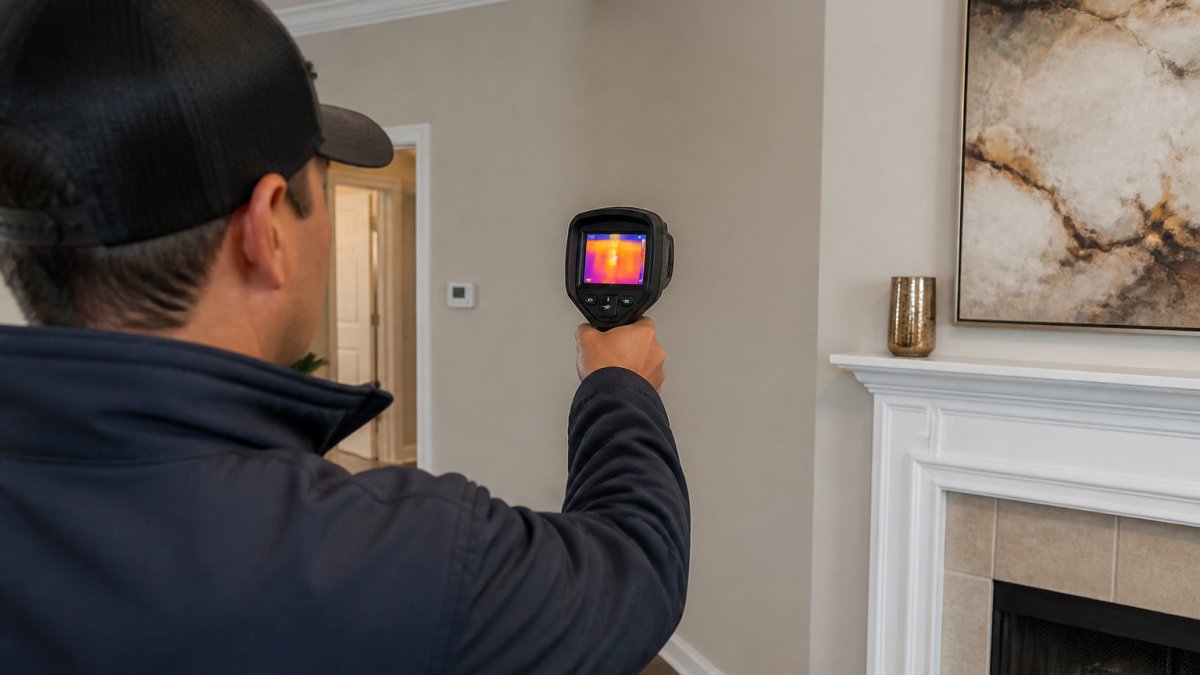
Here are the common findings, with the mechanism behind each one:
- Cold spots along walls and ceilings. Missing or compressed insulation lets heat escape faster, so the interior surface reads cooler than surrounding areas. A rectangular or batts-shaped pattern is a stronger signal than a single irregular blob.
- Warm or cool patches near windows and doors. Air leakage carries heat across the gap, creating a streaky or halo-shaped pattern at the frame. A draft often shows as a vertical smear rather than a clean geometric shape.
- Damp areas that run cooler than dry material nearby. Water has a higher thermal mass and evaporates slowly, so wet drywall, framing, or subfloor typically reads cooler than adjacent dry material, especially after the home has been heated or cooled for a while. Irregular, spreading edges are more consistent with moisture than a sharp-edged cold patch.
- Hot spots on electrical panels, breakers, and equipment. Loose connections and overloaded circuits generate resistance heat. A breaker or wire that reads noticeably warmer than its neighbors under load is a legitimate reason to call an electrician, though a warm panel after heavy use is not automatically a fault.
- Roof and ceiling anomalies. Missing insulation, wet decking, or sky-lighting leaks often appear as distinct thermal shapes from inside the attic or from a drone above the roof.
A hot spot or cold spot is a signal, not a diagnosis. Its meaning depends on what is nearby and what the rest of the inspection shows. Two patterns that look identical in color can have completely different causes, which is why the interpretation guidance below matters as much as the camera itself.
A useful rule of thumb: geometric, repeating patterns (batts, studs, framing) often point to insulation or construction issues, while irregular, spreading, or streaky patterns can point to moisture or air movement. Neither rule replaces a physical check.
The table below summarises the common findings a thermal camera can flag in a house and what each usually points to.
| Finding | Typical pattern | What it may indicate |
|---|---|---|
| Cold spots on walls and ceilings | Rectangular or batts-shaped cool area | Missing or compressed insulation |
| Warm or cool patches near windows and doors | Vertical smear or halo at the frame | Air leakage or drafts |
| Damp areas | Irregular, spreading cool edges | Possible moisture |
| Hot spots on panels and breakers | Warmer than neighbouring components under load | Loose connection or overload, call an electrician |
| Roof and ceiling anomalies | Distinct thermal shapes from attic or drone | Missing insulation, wet decking, or leaks |
Using Thermal Imaging for Home Insulation Checks
Thermal imaging is useful for insulation checks because heat loss shows up on surfaces. When insulation is missing or uneven, the wall or ceiling often shows a temperature pattern that stands out in the image.
Inspectors look for patterns, such as a band of cooler surface along an exterior wall or a section of ceiling that reads differently from the rest. These patterns help direct attention to areas where the insulation may need review.
Thermal imaging does not measure how much insulation is installed or what its R-value is. It shows where temperature behaves differently, and that thermal imaging reveal helps decide where to look more closely. Overview of thermal imaging uses in building inspections
Using Thermal Imaging for Moisture Detection
Water changes how a surface holds heat. Wet material often reads cooler than dry material nearby. That is why thermal imaging can help flag possible water leaks or damp areas inside walls and ceilings.
The method has limits. A cool spot might be moisture, or it might be a draft, a shaded area, or a surface that simply cooled faster. For this reason, inspectors treat thermal findings as leads and check them with other methods.
Moisture questions matter in a purchase.
How to Read a Thermal Image Without Misreading It
A thermal image is easy to misread. Bright colors draw the eye, but color only shows relative temperature in that particular image.
Follow these steps when reviewing a thermal image:
- Check the temperature scale. Colors mean different things depending on the range the camera is set to.
- Compare like with like. A window and a solid wall should not be judged by the same standard.
- Look for patterns. A single odd spot matters less than a repeated shape or line.
- Consider the conditions. Recent sun, rain, heating, or cooling can change readings.
- Confirm before concluding. A thermal finding needs a second check, such as a moisture meter or a visual look, before it is treated as a defect.
Reading a thermal image well takes training and context. A camera does not interpret itself.
Thermal Imaging Inspection Limitations You Should Know
Thermal imaging is powerful, but it has clear limits. Knowing them keeps expectations realistic, and corrects several misconceptions that show up in almost every conversation about infrared cameras.
It does not see through walls. This is the most common misunderstanding. A thermal camera detects infrared radiation emitted by the surface facing the lens. It cannot image objects behind drywall, behind siding, or inside a closed cavity. What it can do is reveal surface temperature patterns that are consistent with conditions behind the surface, a cool band where insulation is missing, a warm streak where a duct is leaking. The image is a clue about a surface, not a window into the wall.
It does not measure insulation R-value or moisture content directly. A camera reports temperature, not R-value and not moisture percentage. A cold surface might mean thin insulation, a wet cavity, a draft, or simply a shaded exterior wall that cooled overnight. Confirming the cause requires a second method, a moisture meter, a visual inspection, or a probe.
Environmental conditions can hide or create patterns. Solar loading (sun heating a wall), recent rain, HVAC operation, wind, and even the time of day all shift surface temperatures. A wall inspected in direct afternoon sun may read uniformly warm and mask a real insulation gap; the same wall inspected before dawn often shows the pattern clearly. Inspections are often timed for early-morning or evening conditions, or interior and exterior readings are compared, because conditions matter this much.
A normal reading does not prove the absence of a problem. Thermal imaging is a screening tool. A wall that reads uniform may still have a small leak, a hidden electrical issue that only appears under load, or insulation that is present but compromised in a way the current conditions do not expose.
It is not a medical or safety screening tool for people. The U.S. Food and Drug Administration has warned about improper use of thermal imaging devices, and its regulations cover systems intended to measure a person’s surface skin temperature. Elevated skin temperature is not a diagnosis of illness, and a thermal camera used in a home inspection is a different application entirely. The broader lesson holds: a thermal image is one piece of evidence and should not be stretched beyond what it can show. FDA alert on improper use of thermal imaging devices
Reflections and emissivity can mislead. Shiny surfaces, metal ductwork, foil-faced insulation, polished appliances, reflect infrared radiation from nearby objects, so the camera may report a temperature that belongs to a reflection rather than the surface itself. Low-emissivity surfaces also read artificially cool or warm. Experienced thermographers adjust for emissivity, change viewing angle, or confirm with a contact thermometer.
Treat every thermal image as a lead, not a verdict. The most reliable inspections pair the camera with a moisture meter, a visual walk-through, and, where electrical or structural concerns arise, a licensed specialist.
Booking a Thermal-Equipped Inspection for Your Next Purchase
If you are buying, selling, or investing, a thermal-equipped inspection can add useful detail to the report. At Zenith Property Inspections, we use infrared thermal imaging and DJI drone technology as part of our inspections. Our inspectors are National Housing Code Certified Master Inspectors, and our reports are delivered the same day. Broadening this diagnostic scope to include a thermal drone inspection provides a comprehensive perspective on structural integrity that ground-level assessments alone might overlook.
Saturday and Sunday appointments are available at no extra charge, so the inspection can fit around a busy work week. To see what fits your property, schedule your inspection or read what the cost of a thermal imaging inspection looks like before you decide.
Frequently Asked Questions
Can a thermal camera on a phone reveal the same things as a professional camera?
Phone-attached thermal accessories can show surface temperature differences, but they usually have lower resolution, less thermal sensitivity and narrower temperature ranges than professional inspection cameras. They can help a homeowner spot an obvious warm or cold area, but they are not a substitute for a trained inspector’s camera, calibration and interpretation. For a home purchase, a licensed inspector using a professional-grade camera gives a more reliable result and a report you can act on.
Can a thermal camera see through a house?
No. Thermal cameras read the heat radiating from surfaces, not objects hidden inside solid walls. A warm or cool pattern on a wall can suggest what lies behind it, such as missing insulation, a moisture problem or a heated pipe, but the camera does not show the object itself. Confirming these patterns usually requires a second method, such as a moisture meter.
Can thermal imaging detect insulation gaps?
Yes, thermal imaging often shows insulation gaps as irregular cool areas on walls, ceilings and floors during a temperature difference, typically when indoor and outdoor temperatures differ by a meaningful margin. Gaps look different from a uniform insulated surface, which is why inspectors compare patterns across the whole room. A thermal finding identifies where to look further, and it is best confirmed with a visual or physical check before repair decisions are made.
What can thermal imaging not detect?
Thermal imaging cannot see through solid materials, identify the cause of a problem on its own, or reliably detect issues that have no temperature difference, such as some dry structural cracks or hidden pests. It also cannot measure moisture content precisely, so a suspected leak should be checked with a moisture meter. Results depend on weather, timing and surface materials, so a clean image does not prove that a building is free of defects.
